Open a facsimile of the 1611 King James Bible and count the contents page. You will not get 66.
You will get 80. Thirty-nine Old Testament books, twenty-seven New Testament books, and fourteen more sitting in a section of their own between the Testaments.
Those fourteen are not a rumour and not a conspiracy. They were printed, bound, sold and read in English Bibles for generations. Here is what they were and how they left.
The Fourteen
As the 1611 contents page lists them: 1 Esdras, 2 Esdras, Tobit, Judith, the Rest of Esther, the Wisdom of Solomon, Ecclesiasticus (also called Sirach), Baruch with the Epistle of Jeremiah, the Song of the Three Children, Susanna, Bel and the Dragon, the Prayer of Manasses, 1 Maccabees and 2 Maccabees.
Some are histories. Some are wisdom literature that reads like Proverbs. Some, like Susanna and Bel and the Dragon, are short narrative episodes attached to Daniel.
Nobody Burned Them
The story is less dramatic than the internet version, and more interesting.
First came the theology. The Church of England's Thirty-Nine Articles (1563) held that these books are read "for example of life and instruction of manners" but are not used to establish doctrine. The Westminster Confession (1647) went further and said they are "no part of the canon of Scripture." So their status was settled long before their pages went anywhere.
Then came the printing. In 1826 the British and Foreign Bible Society, by then one of the great engines of mass Bible distribution, resolved that its funds would not pay to print the Apocrypha, a decision driven heavily by cost and by pressure from its Scottish members. Cheap Bibles became Bibles without that section, and within a couple of generations most English-speaking Protestants had never held one that included it.
That is the whole mechanism. A doctrinal demotion, then a printing economy. The same story, told across four traditions, is here.
What This Has to Do With Ethiopia
While that was happening in Britain, the Ethiopian Orthodox Tewahedo Church had never gone through the argument at all. Its scriptures were translated in the early centuries of the faith and were never put through the narrowing that shaped Western Bibles. The men who did that translating are worth knowing about.
So a reader who wants the 1611 experience back has an unusual option: an English edition of the Ethiopian canon carries 12 of those 14 books. 1 Esdras, 2 Esdras, Tobit, Judith, the Rest of Esther, Wisdom, Sirach, Baruch and the Epistle of Jeremiah, Susanna, the Song of the Three, Bel and the Dragon, and the Prayer of Manasseh are all there.
The two it does not carry are 1 and 2 Maccabees. In their place the Ethiopian canon has three entirely different books called Meqabyan, which are not translations of the Greek Maccabees and tell completely different stories. We wrote up what is actually in them.
We would rather tell you that plainly than let you find out after the box arrives.
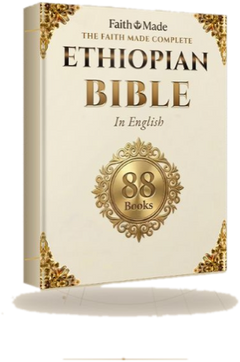
The Faith Made Complete Ethiopian Bible is an 88-book English edition: the sixty-six you already own, twelve of the fourteen the 1611 King James carried, and the books that survived only in Ethiopia, including Enoch, Jubilees and Meqabyan.
Where this comes from. A plain-language summary of published historical scholarship. Ancient dates and counts are reconstructions, and where scholars disagree this article says so. Scripture quotations are from the King James Version.