Ask how many books are in the Bible and the answer changes with who you ask. Most Protestants say 66. Catholics say 73. Eastern Orthodox churches land around 76. And the Ethiopian Orthodox Tewahedo Church, counted book by book, comes to 88.
None of those numbers is a mistake. Each one is the end of a long, documented road, and the roads went different directions.
Where 66 Came From
The Protestant 66 is a decision, not an accident. The Reformers chose to follow the shorter Hebrew Bible for the Old Testament and set aside a body of Second Temple Jewish writings that had circulated for centuries in Greek. Luther did not burn them. He moved them into a separate section of his German Bible. The 1611 King James Bible did the same thing, printing them between the Testaments.
Two things then happened, and they are often blurred together. First, Reformed confessions ruled on their status: the Church of England's Thirty-Nine Articles (1563) said the church reads them "for example of life and instruction of manners" but does not use them to establish doctrine, and the Westminster Confession (1647) stated plainly that they are "no part of the canon of Scripture." Second, and much later, the distribution changed: in 1826 the British and Foreign Bible Society resolved that its funds would not pay to print the Apocrypha, a decision driven heavily by cost and by pressure from Scottish members. Between the theology and the printing economics, the section quietly disappeared from the Bibles most English-speaking Protestants grew up holding. We listed all fourteen of those books, and what became of them, here.
Where 73 and 76 Came From
The Catholic Church kept seven of those texts, the deuterocanonical books, for a total of 73. That reflects the older Greek Septuagint tradition, and it was formally affirmed at the Council of Trent in 1546, in direct response to the Reformation.
Eastern Orthodox churches kept a wider set still, commonly totalled near 76. The exact figure varies by jurisdiction and by whether texts such as 3 Maccabees, Psalm 151 and the Prayer of Manasseh are counted separately or as appendices.
Where 88 Came From
Ethiopia is the outlier, and the reason is partly geography and partly bookkeeping.
Christianity reached the kingdom of Aksum in the 4th century, early enough that the broad library of Jewish and early Christian writings still in circulation went into the Ge'ez scriptures as a matter of course. Then distance did the rest. The councils that narrowed other canons met in Rome, in Carthage, in Constantinople. Ethiopia was not in the room.
List that canon out title by title and you get 88 books. That is the number in English-language editions, including ours, because it is what you land on when you count what is actually there: three books of Meqabyan rather than one heading, the separated sections of Proverbs, and so on.
You will also see the round figure 81 quoted, and it is worth knowing why. It comes from the medieval Fetha Nagast law code, which states a total of 81 and then lists only 73 titles. Ethiopian scholars have filled that eight-title gap in more than one way over the centuries, which is why totals of 81, 88 and 89 all appear in the literature for the same tradition. Scholars describe the Ethiopian canon as effectively "neither open nor closed" for exactly this reason. Nobody disputes the contents. They differ on how to bundle them.
Either way it is the largest canon in Christianity, and it is the only one that still carries Enoch, Jubilees, and the three books of Meqabyan. Those last three are not the Maccabees you are thinking of.
The Part Nobody Argues About
Here is what surprises people most: on the books these traditions share, they are not in conflict about whether those books belong. Genesis is Genesis. John is John. There are real textual differences between manuscript traditions, particularly in Esther and Daniel, but the headline gap in the counts comes from which additional books a community kept reading as scripture, and which ones it stopped reading.
One community never stopped.
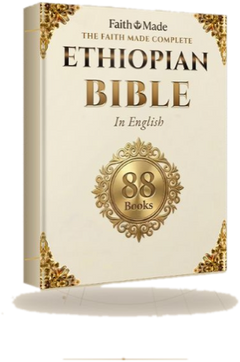
The Faith Made Complete Ethiopian Bible presents that canon in English as 88 books in one volume, so you can read the ones your Bible leaves out and count them yourself.
Where this comes from. A plain-language summary of published historical scholarship. Ancient dates and counts are reconstructions, and where scholars disagree this article says so.