Picture nine monks arriving on foot in the highland kingdom of Aksum in the late 5th century. Most of them are refugees.
In 451 AD the Council of Chalcedon adopted a definition of Christ's nature that their side of the church rejected, and those who refused it were condemned. Rather than accept it, they left. Tradition says they came from Syria and from as far as Constantinople and Rome, and that they made their way to Ethiopia, a kingdom that had accepted Christianity about a century earlier.
History remembers them as the Nine Saints. Nearly everything we know about them comes from Ethiopian hagiography written down long after the fact, so the details of who they were and exactly where they came from are traditional rather than documented. What is not in doubt is what happened to the scriptures in their century. One of the nine, Abba Garima, has two Gospel books at his monastery that have been radiocarbon dated to late antiquity. They are the oldest illustrated Christian books in the world.
The Translation Did Not Start With Them
Work on a Ge'ez Bible had already begun in the 4th century, under King Ezana and the first bishop, Frumentius, when portions used in worship were put into the language. The Nine Saints are credited with the far larger job: carrying the translation through to the whole Bible, working from Greek texts with some reference to Syriac.
Scholars who study the Ethiopic Bible point to evidence inside the translation itself. The style shifts noticeably from book to book, which suggests several hands working on different portions rather than one voice smoothing everything into a single register.
Why Enoch Went In Without a Fight
This is the detail that decided what the Ethiopian canon would contain.
The Greek and Syriac Christian world those translators drew from still circulated Enoch and Jubilees as part of its ordinary religious library. Accounts of the translation describe it being carried out without a formal sorting of canonical from non-canonical books. So those texts went into Ge'ez alongside the rest, and no Ethiopian council is recorded as ever having voted them in or out.
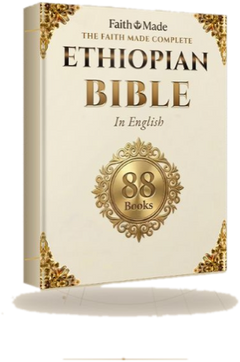
While bishops elsewhere spent the following centuries arguing about exactly where the boundary of scripture should fall, sometimes ruling one way and later the other on the very same books, the Ethiopian scriptures were never put through that narrowing. They stayed roughly as they started. Counted title by title, the way English-language editions list them, that canon comes to 88 books.
Nine monks fleeing a council they had lost ended up preserving more of the ancient Christian library than the empire that condemned them ever kept for itself.
The Faith Made Complete Ethiopian Bible carries that canon into English as 88 books.
Where this comes from. A plain-language summary of published historical scholarship. Ancient dates and counts are reconstructions, and where scholars disagree this article says so.