Scripture footnotes itself. Several times, a biblical writer pauses to point the reader at another book, the way a historian cites a source.
Those books are not in your Bible. Most of them are not in anyone's.
The Citations
After the sun stands still at Gibeon, the text asks: "Is not this written in the book of Jasher?" (Joshua 10:13). David's lament for Saul and Jonathan carries the same pointer (2 Samuel 1:18). Numbers 21:14 quotes "the book of the wars of the LORD." First Chronicles 29:29 sends the reader to "the book of Samuel the seer," "the book of Nathan the prophet" and "the book of Gad the seer." Paul tells the Colossians to read "the epistle from Laodicea" (Colossians 4:16).
None of those survive. They were real documents in circulation when the biblical text was written, and time took them.
About That Book of Jasher on Sale
Type "Book of Jasher" into any bookseller and you will find it in stock. It is worth knowing what you are actually buying.
There are two separate texts using the name, and neither is the book Joshua cites.
The first was published in 1751, presented as a translation made by the eighth-century scholar Alcuin of York. It was a literary forgery by Jacob Ilive, recognised as such at the time, and reprints still circulate with Alcuin's name attached.
The second, which is behind nearly every copy sold today, is a Hebrew midrashic work, Sefer haYashar, printed at Venice in 1625 and translated into English in New York in 1840. It is a genuine old book and an interesting one. It is also medieval, most likely composed in Spain, and it is not the source Joshua was pointing at.
We are in the business of selling ancient books, and we are telling you this anyway, because the alternative is selling you a story that falls apart the first time you check it.
Why Enoch Is the Opposite Case
Set Jasher next to Enoch and the contrast is the whole point.
Enoch is quoted in the New Testament by name: "And Enoch also, the seventh from Adam, prophesied of these" (Jude 1:14). Copies of it in Aramaic were recovered from the caves at Qumran, so we know it was being read before the time of Christ. And it survives complete, in Ge'ez, because the Ethiopian Orthodox Tewahedo Church never stopped copying it. The Qumran find is worth reading about on its own.
Lost, forged, and preserved are three different categories. Jasher is lost and imitated. Enoch was preserved, in one place, by one church. Why that church's canon runs longer than yours.
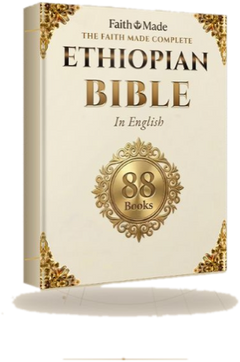
The Faith Made Complete Ethiopian Bible carries Enoch and Jubilees complete in English inside an 88-book edition. It does not contain Jasher, because nobody has it.
Where this comes from. A plain-language summary of published historical scholarship. Ancient dates and counts are reconstructions, and where scholars disagree this article says so. Scripture quotations are from the King James Version.