Philip is told to take the desert road from Jerusalem down toward Gaza. He meets a chariot. Inside is a court official described as "a man of Ethiopia, an eunuch of great authority under Candace queen of the Ethiopians, who had the charge of all her treasure" (Acts 8:27).
The man is reading Isaiah aloud and cannot make sense of it. Philip explains the passage, the official asks to be baptised, and the chariot stops at water.
It is one of the most striking conversion accounts in the New Testament, and it is routinely preached with one detail quietly wrong.
"Candace" Is Not a Name
Candace renders the title Kandake, used for the queens of the kingdom of Kush, centred on Meroë in what is now Sudan. It is a royal office, not a personal name, and from roughly 170 BC onward it could designate a woman ruling in her own right. Luke is using the correct first-century term for a real African court, which is one of the small details that anchors the account in a verifiable political world.
And "Ethiopia" Is Not Ethiopia
Here is the part that gets skipped. In Greek usage of that period, "Ethiopia" meant essentially everything south of Egypt. The official in Acts 8 almost certainly served the Kushite court at Meroë, not the highland kingdom that became modern Ethiopia.
The Ethiopian Orthodox Tewahedo Church nonetheless honours him as a founding figure. That is a claim of spiritual inheritance, and it is worth understanding as exactly that rather than as a geography lesson.
Where the Hard Evidence Starts
The documented Christianisation of the Aksumite kingdom comes later and rests on firmer ground. In the 4th century, under King Ezana, the faith became the religion of the court. You can see the turn in the coinage: Aksumite coins that had carried a disc and crescent begin carrying a cross. Frumentius, remembered in Ethiopia as Abba Salama, was consecrated as the first bishop, and the work of putting scripture into Ge'ez began.
That is not legend. It is minted metal and inscriptions.
What came after is the part most readers have never been told: because that church sat outside the councils that later narrowed other canons, its Bible kept books the rest of Christendom stopped copying. The translators who fixed that canon were refugees from a church council.
The official in the chariot was reading Isaiah, a book you already own. The tradition that claims him kept reading several that you do not.
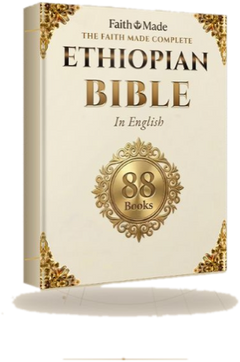
The Faith Made Complete Ethiopian Bible brings that canon into English as 88 books, including Enoch, Jubilees and the three books of Meqabyan.
Where this comes from. A plain-language summary of published historical scholarship. Ancient dates and counts are reconstructions, and where scholars disagree this article says so. Scripture quotations are from the King James Version.